
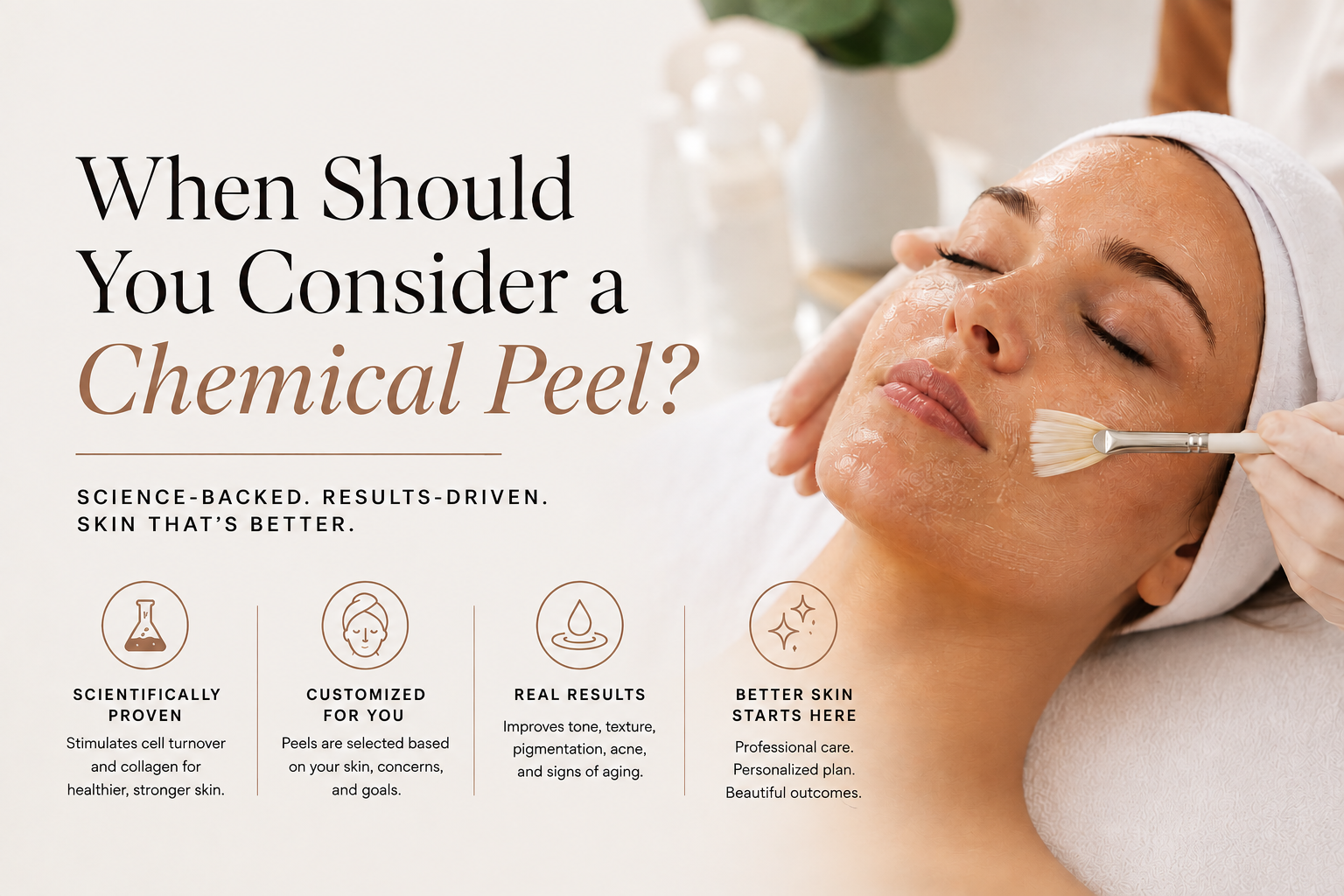
Chemical peels have been around for decades, but they remain one of the most versatile tools in aesthetic skincare. The right peel can help improve uneven pigmentation, acne, rough texture, fine lines, sun damage, and overall skin quality—without necessarily requiring significant downtime.
But here’s the key: not every peel is right for every person or every skin concern. At Better Aesthetics, we believe the best results come from choosing the right treatment for your skin—not simply choosing the strongest treatment available.
So, when should you consider a chemical peel?
Your skin may be asking for a peel if…
You’re noticing:
- Dull or tired-looking skin
- Uneven skin tone or pigmentation
- Sun damage or brown spots
- Rough or uneven texture
- Fine lines
- Enlarged-looking pores
- Acne or congestion
- Post-acne discoloration
- Skin that just doesn’t seem to respond to your regular skincare routine
Chemical peels can be used to address many of these concerns, depending on the type and depth of peel selected.
And sometimes, you don’t have a major skin concern at all—you simply want to refresh your skin and improve its overall quality.
That’s where a well-selected superficial peel can be especially useful.
So…what exactly does a chemical peel do?
Let’s get a little scientific.
A chemical peel uses a carefully selected chemical solution to create a controlled injury to the skin. That sounds dramatic, but controlled is the important word.
Depending on the type, concentration, pH, and application technique, the solution can work primarily within the epidermis or extend deeper into the skin. This controlled process removes damaged or abnormal cells and activates the skin’s natural repair and regeneration processes.
Here’s what happens at a cellular level:
1. The peel loosens and removes damaged surface cells.
Ingredients such as glycolic acid, lactic acid, salicylic acid, and other peeling agents disrupt the connections between cells in the outermost layers of the skin. This helps remove accumulated dead skin cells and encourages a more even epidermal surface (that means skin)
2. The skin begins its repair process.
The controlled injury triggers an inflammatory healing response. Your skin essentially receives a signal that it’s time to repair and rebuild.
3. New skin cells regenerate.
As older, damaged cells are shed, healthier keratinocytes repopulate the epidermis (a new layer of skin)
4. Deeper remodeling can occur with certain peels.
Depending on the depth of the peel, the healing response can stimulate changes in the dermis, including increased collagen production and remodeling of the skin’s structural framework.
In other words, a chemical peel isn’t simply “taking the top layer off.”
It’s using a controlled biological response to encourage new, healthier skin.
Not All Chemical Peels Are Created Equal
One of the biggest misconceptions about chemical peels is that a stronger peel automatically means better results.
It doesn’t.
Chemical peels are generally classified as superficial, medium-depth, or deep, based on how deeply they affect the skin.
Superficial Peels
These primarily target the epidermis and are often used to improve:
- Dullness
- Mild pigmentation
- Uneven tone
- Rough texture
- Acne and congestion
- Early signs of photoaging
These are often the “lunchtime” peels with relatively little downtime. Multiple treatments may be recommended to build results over time.
Medium-Depth Peels
These penetrate farther into the skin and can be used for more significant concerns such as pigmentation, sun damage, fine lines, and certain textural concerns.
They typically involve more redness, peeling, and downtime than superficial peels.
Deep Peels
Deep chemical peels reach significantly deeper into the skin and are associated with substantially more downtime and risk. These are medical procedures that require careful patient selection and appropriate medical supervision.
At Better, our goal isn’t to peel as deeply as possible. It’s to select the appropriate treatment for your skin and your goals.
What Happens During a Chemical Peel?
Before your treatment, your skin will be evaluated to determine whether a peel is appropriate and which formulation is best suited to your skin.
Depending on the peel, you may have a recommended skincare routine leading up to your appointment.
During your treatment, your skin is thoroughly cleansed and prepared. The peel solution is then applied in a controlled manner while your provider carefully observes your skin’s response.
What does it feel like?
You may experience:
- Tingling
- Warmth
- Mild stinging
- Tightness
The sensation varies depending on the specific peel and its depth. And no—you don’t necessarily need to “feel like you’re on fire” for a peel to work. The goal is a controlled, appropriate treatment—not maximum discomfort.
After the appropriate amount of time, the product is removed or neutralized depending on the formulation, and soothing skincare is applied. This is why chemical peels should not be done at home. This is chemistry and you must be trained in chemical reactions and properly neutralizing the active response. In the wrong hands a chemical peel could leave scarring and discoloration.
What Should You Expect After Your Peel?
This is where patience becomes important. Your skin may initially look: A little pink. A little tight. Maybe even a little shiny. We are talking glass skin here!
Over the following days, you may experience dryness, flaking, or peeling as the treated skin sheds and the regeneration process continues. Peeling typically begins on day 3 after the peel was applied.
With superficial peels, healing can range from approximately 1–7 days, although the amount of visible peeling varies considerably. Some people peel noticeably, while others experience very little visible peeling.
And here’s something important: More peeling does NOT necessarily mean a better peel. The goal is not to create as much peeling as possible. The goal is to create the appropriate biological response for your skin and your treatment goals.
Your Post-Peel Routine Matters
What you do after your peel can have a major impact on your recovery. Follow the directions given in your appointment. This is not the time to try the latest TikTok trend!
Cleanse gently.
Moisturize generously.
Protect your skin from the sun.
Leave the flakes alone. Avoid picking, peeling, or pulling at shedding skin. Your skin is actively repairing itself, and disrupting that process can increase irritation and the risk of complications.
And sunscreen isn’t OPTIONAL. Your newly treated skin is particularly vulnerable to environmental exposure, so consistent sun protection is an essential part of maintaining your results and minimizing unwanted pigmentation. You wouldn’t take a newborn baby in the sun, treat your new skin the same way.
Your provider may also temporarily have you pause certain active ingredients—such as retinoids or exfoliating acids—depending on the peel and your individual skin.
How Often Should You Get a Chemical Peel?
That depends on the peel, your skin, and your goals.
For some patients, a single treatment can provide a noticeable refresh. For others, a series of superficial peels produces better results over time.
The American Academy of Dermatology notes that patients receiving refreshing or lunchtime peels may need several treatments, sometimes spaced a few weeks apart, to achieve their desired results. A consultation with Shannon (your favorite Aesthetician) is the best way to decide which peel is right for you.
Think of it less as a one-time “skin reset” and more as strategic skin remodeling.
When Might a Chemical Peel NOT Be the Best Choice?
A peel isn’t automatically the answer for every skin concern.
Active irritation, certain skin conditions, recent procedures, medications, a history of abnormal scarring, or increased risk of post-inflammatory pigmentation may influence whether a peel is appropriate.
Skin tone also matters. People with darker skin tones can absolutely be candidates for chemical peels, but treatment selection and technique are especially important because deeper peels and inappropriate treatment can increase the risk of pigmentary complications.
This is exactly why professional skin assessment matters.
The Better Approach to Chemical Peels
At Better Aesthetics, we don’t believe in chasing the strongest treatment just because we can. We believe in understanding your skin, your concerns, your lifestyle, and your goals and then choosing the treatment that makes sense. Sometimes that’s a chemical peel. Sometimes it’s a series. Sometimes it’s another treatment entirely.
Because great skin isn’t about doing more. It’s about doing what your skin actually needs.
